Tuesday, November 23, 2021

Pop Culture Rewind: Begin Again and the Paradoxical Place of Music Films

So, after the brutal, disturbing viewing experience that was Squid Game, I decided to venture into some feel-good territory. Netflix suggested Begin Again, and I thought "Mark Ruffalo? Keira Knightly? Adam Levine? How have I not seen this?" The answer is - I might have - but it was released in 2013 which was the year of postpartum depression and a breastfeeding infant - so if I saw it, I forgot about it. 


But I decided to give it another shot and now I CAN'T. STOP. Thinking about it. (BTW - I will spoil this if you haven't seen it - just so you know) 

First, let me say I don't think this film aged particularly well - much like a lot of music films. I'm the first person to defend Empire Records because I LOVE it, yet I'm highly aware that it didn't age well and is a product of its time (but I will always be down for Rex Manning Day). Begin Again is in the same boat for me - its core argument that the internet will free artists from labels taking their money and messing up their artistic vision isn't wrong exactly. It just feels outdated given that Alexa is now streaming the whole soundtrack for me as I write this. 

That said, what captivated me so concretely about this film were the delicate performances Ruffalo and Knightly managed that developed an intimate, meaningful relationship that told a different kind of love story. It's not about boy meets girl and happily ever after - it's about boy meets girl when they are both broken and somehow meeting manages to help them both become better versions of themselves. They confront their internal faults, discover their own weaknesses, and working creatively together makes them stronger and more functional humans. Isn't that a real love story? 


Levine is clearly not an actor, but he did pretty well, especially when scenes allowed him to use musical performance in lieu of dialogue. The other characters in the film are basically thin caricatures (except for Catherine Keener, who is woefully underutilized, isn't given much to work with and still manages to be brilliant). 

Probably what hit me the hardest is the music. If you have ever worked with musicians or have a musical brain at all, you've had those interactions where someone "hears" things others don't. Early in the film, Knightly sings a super depressing acoustic guitar piece at an open mic night and is basically panned by the crowd. It's just her, a very simple melody and a guitar. She knows it kinda sucked and she can't get off the stage fast enough. Then you see the scene again through Ruffalo's character, and I've never seen a better capture of how a musical brain works - he hears the score and the harmony over Knightly's performance and is captivated. As the audience, since you saw version one and then see version two, you now see what the musical brain sees: 


Given that this film seemed to appear and fade away without much fanfare, it obviously wasn't music that took the world by storm. But my colleague Jenn Billinson and I wrote about how soundtracking a story, even with music you wouldn't think stands alone well, can fundamentally change both the story and the emotion in a visual piece. And even when the music has quite literal meanings connected to the story - as is the case for the songs in this film - the layers of relational development allow you to read the pieces against more than what they are penned to mean. It's been damn near impossible to get out of my head. If you like music films and you haven't seen this - or it's been a while and you forgot about it - maybe revisit it. Perhaps you'll see something new and it'll unlock something for you emotionally like it did for me.

Sunday, November 7, 2021

Squid Game, the Death Lottery and the Pandemic

So, when my students started asking, "Have you seen Squid Game yet?" I had the same reaction I did to their obsession with You. Thanks, but no thanks. I don't need to see some dude stalk and kill women. As far as I could tell, Squid Game was another version of that kind of thing - a needlessly violent poor choice of entertainment. But after weeks and weeks of chatter, I decided to give it a try when I saw the number of Squid Game costumes at Halloween and reading that it now surpasses Bridgerton (which is right in my wheelhouse) as the most successful television series on Netflix. So, I watched it. And now for the first time in like - well, seven years - I felt I needed to put some blogging out into the world. 

 ***There will be (blood) spoilers. If you don’t want them, don't read further*** 


The premise of Squid Game is sort of like The Hunger Games, but with a few key differences. In The Hunger Games, you got picked to play basically out of bad luck. It sucks to be you - you did nothing wrong, but there are coaches, engineers and audience "helpers" that are able to give you some advantages here and there. In Squid Game, there are some questionable, yet plausible, issues related to consent and social contracts as to you "choosing" to play in the games. In essence, every character in Squid Game is in some kind of financial crisis *of their own making* (supposedly), and the premise is that winning the game would change their lives financially. 


So, here's where I've been so tripped up by the narrative - what seems to have resonated with most US American viewers is the supposed critique of capitalism and financial systemic inequality, particularly given Korea's history. I just don't see the critique of capitalism as strongly as others - how is it a critique of capitalism when you are basically substituting the financial purchase of a lottery ticket with a signature of your life? Your life apparently still has capital value that they are willing to take and then translate literally into cash money when you die. They literally show the money falling into the pig after you die. That's what you were worth. Basically, Squid Game is a Death Lottery where the audience is gonna laugh at you like WipeOut when you die because you deserved it for being the dumbass that signed up. 

Like entering the lottery, the odds of winning in each game are rigged. At one point in the fifth game, a character we've been introduced to as a math teacher is standing calculating his risk chances of crossing a bridge of glass - pick the right pane, make it safely, pick the wrong one, crash through it and fall to your death. He does some figures in his head and comes up with some astronomical number and knows he has basically no chance of surviving (this person did the math). 

Those hosting the game describe it as the "last fair chance" people have of making their own way in the world without systemic advantages. But there are advantages - some contestants cheat, and they get ahead - sure they punish one, but they never caught the others. Some are betrayed by human emotion - trusting people at the wrong moment. And the fact that the narrative says these advantages don't exist because they've leveled inequality is just flat out wrong unless you only see inequality as financial - not racial, gendered, social, emotional, legal, etc. It's far more intersectional than that - I mean, anyone that watches Sang-woo betray Ali and doesn't get that missed the entire point (To be fair, I don't speak Korean - I do speak Japanese though, and, thus, the honorifics, though different, did translate for me, which made the Sang-woo/Ali betrayal all the more devastating). The fact that Gi-hun talks about maybe there being some advantages to having women on their teams, only to have every game NOT have an advantage for women just goes to show that women who signed up were in a shittier position to win. 

So, a lot of the "down with capitalism" critique for me really read like a shoji screen for let's make this as dramatically gory and bloody as possible without really challenging anything about the issues we say we're challenging. What did resonate more strongly for me rather than this larger capitalism argument was the visual representation of despair at being unable to control and alter one's life circumstances - that the illusion of choice is not only seductive by deadly. I mean, if this image doesn't capture that, I don't know what does:


I was struck by how many of the storylines featured either 1) addiction as the downfall of these people economically (the protagonist is a gambling addict, the antagonist clearly addicted to gambling in a different form, the lady nobody likes is apparently also addicted to nicotine -- I mean, if I had a choice to smuggle one in thing through my vagina after seeing this place the first time, I don't think five cigarettes would have been my first choice) or 2) social isolation as the main culprit (the girl escaping North Korea, the Pakistani man left disabled by poor labor laws, the big bad guy has several references to drugs and other crime syndicates). It's this aspect of the series that I think resonates quite strongly with pandemic life - whether you are in a "post" or a "still ongoing" place in your ideology. No matter what choice you have in front of you, neither one is good. No one in a position of power is actually going to help you or explain your choices in a manner that allows you to feel like you have actual agency over the outcome. People with more who could help are willing to hoard and keep what they have for themselves. 

So, from that lens, the end of the series where the bet is on whether or not there is any good left in humanity holds some appeal. Perhaps the most powerful moment of coming full-circle is from our opening scenes of horseracing, to when Gi-hun declares that these are people, not horses - maybe that's what it feels like at the moment to live in contemporary society. A lot of us feel like the horses - we're either working and/or being experimented on - and ultimately those with the wealth to solve a number of problems simply won't. Honestly, the subplot of organ harvesting had all of its own issues especially when you read it through the lens of addiction or social failing - the idea that these people don't have a *right* to their bodies any more - that they would be more appropriately used by someone else - was jarring given our legal discussions around vaccines, women's bodies, etc. And after watching the number of people literally eat each other like zombies in the game holding cell and compare that to if this random person stops in the cold to help someone, it's like the same thing? Not exactly. But some parts of it felt a little too real - and maybe that's where the appeal comes from.

Tuesday, February 4, 2014

Breaking the Cycle of Creative Addiction - Consider How We Communicate About Creativity

My social media feeds are packed with the news of Philip Seymour Hoffman’s death, and I can’t help but wonder when we’re going to get to the heart of the matter. Sure, we’ll see all the typical posts about losing another creative soul, the perils of addiction, the need for more medical interventions in mental health. But I want to know when we are going to break that cycle. When do we break the cycle of talking about the same event the same way? I guess that’s my passion as a communication scholar.

Here’s the thing – this story is not new. Lots of creative people die as a result of addiction or overdose. Why? What we should be talking about is how creativity is constructed in society – that our ideological understanding of the arts and other creative pursuits is attached to a deep, inner inspiration and drive. In other words, to truly be a great actor/writer/director/artist/musician/etc, you have to get that inspiration from somewhere. And it should be *natural* – it should come *easily* – and if it doesn’t, then perhaps you don’t have what it takes to be the next big star in any of those fields. Because there is always someone else out there who is making it look easier than you. Someone who is inspired in ways you aren’t, and ultimately, if they exist, then what’s the point of your existence?

Welcome to the mind of a creative soul. A constant self-critique and assessment of your performance in relation to those around you. And when you need to turn on the inspiration, it is – in many instances – a somewhat logical choice to use mind altering substances as a way to do it. Thousands of stories from famous creative people promote alcohol/drug use as part of the creative process. As a result, being creative becomes equated with being a user of alcohol/drugs to achieve inspiration. Sometimes it helps. Sometimes it doesn’t. And sometimes it gets out of control. But this isn’t because these people are necessarily mentally ill, or necessarily in need of assistance – it’s because societally, we believe this is simply part of being a creative person.


What I’d like to see is a discussion of how being creative is a *process* – not part of an inborn, innate creative identity.  A discussion of how being creative is hard, tedious work. Often very hard, very tedious work. Of how it is a constant commitment to producing a ridiculous number of failures before producing your masterpiece. Of how you resolve yourself to the fact that even when/if you produce a masterpiece, perhaps no one ever recognizes it as such (at least while you’re alive, and maybe not even posthumously). To understand that failure is not simply part and parcel of the creative process, but fundamentally that being creative is a resignation of oneself to a *potential lifetime of failure*. Until we start talking about that – until we start redefining what the “creative” means communicatively, or what we expect the outcomes of the creative process to be so as to redefine what constitutes “success” and “failure” in these areas, we will continue to see this story repeated. We will continue to lose creative souls because at the very base of it, culture is often inhospitable to creative people.


Friday, September 20, 2013

Big Brother Season 15 - How Gender and Sexuality Mattered in the End


Though I’m not the biggest fan of reality television, I do have a bit of an unhealthy obsession with Big Brother. I am not a “super fan.” I don’t watch the feeds. I can’t name former houseguests off the top of my head. I’m lucky if I even remember who came in second each year. Some seasons I’m super invested, others I watch casually. But in the end, I enjoy the game because it’s like chess with people. As a communication scholar, I enjoy watching how people navigate relationships in this confined environment, particularly as power shifts from week to week.

This season I watched with great fascination as the discourse about houseguests, CBS/production, racism, homophobia, etc., circulated (all unbeknownst to the houseguests until the game ended Wednesday night). As the game progressed, I was rooting for Andy. There are a lot of reasons I felt Andy was a strong player, and deserved the win at the end (you can read here for a great summary by someone who knows far more about BB than I do – I pretty much agree with every word).


BUT – I can’t get over this nagging feeling. This oddity of hate that continues to circulate about Andy, about his gameplay, and his so called “rat” status. Toward the end, everyone agreed that he should probably win, but no one was really happy about it. And the more I think about it, I have a strong suspicion that this discourse is firmly rooted in gender and sexuality. First, I doubt Andy would have incurred the title of “rat” if he were female. Women ducking into rooms, gossiping about other players and whatnot wouldn’t be seen as “rat” behavior – it would be expected. If a woman played the same style of game, she’d probably be complimented on her social game. And eventually, that behavior, because of her position as female, would be seen as threatening to other players and she’d be voted out. Andy was able to play this type of game successfully because of his positionality as male.

Similarly, as the only gay houseguest (and one that the other houseguests marked early as effeminate), his sexuality influenced this positionality. Andy’s behavior was seen as anti-masculine from the start. He was not included in the male discussions of alliances early in the season. As a player, he was ignored by the more masculine men (and the aggressive women) as a weak threat at best. To play a more aggressive game (as many fans were calling for “big moves” and “stronger” gameplay from Andy) would have been suicidal. He is the first openly gay houseguest to win – and I’m not sure that ANY OTHER type of game played by a gay contestant would have been successful, especially given the rampant racism and homophobia expressed by this season of houseguests. It makes me wonder if there would be any other way for a gay houseguest to play this game in the “strong” way fans seemed to want without making them a target for eviction. Homophobia is real. It’s ugly. And no matter how much “progress” we’ve made, throw 16 people in a house for three months – 16 people cast specifically because they are different so as to instigate the most drama – and you’re not exactly going to get an ideal, utopian social experiment where everyone can just get along.

So, I am content with the season and how it ended, but had to get my thoughts out about this. It’s about time I updated the blog anyway. Now you’ll all just have to wait another two years for something to be interesting enough for me to blog about.

Thursday, August 4, 2011

I Promised Comic Book Film Reviews...

I just realized that it's August. Which means I missed July entirely on this blog. So let's start out August right. Comic book movies!

Green Lanturn - W.T.F.!!! I'm very happy to report that on a friend's suggestion, I didn't actually PAY to see this film, rather ducked in after seeing another film I paid for (Super 8 - fantastic, should write a review on that). This film was the worst film I've seen since Johnny Mnemonic.


You're cute Ryan Reynolds, but NOT THAT CUTE!! Keanu barely saved his ass from that terrible film. My favorite part of Green Lanturn was sipping rum from a flask and bantering with my friends about the whole mask thing - moronic! You could totally tell it was Ryan Reynolds. Not like Batman at all. Lame sauce. Two thumbs down! Comic books are ashamed to be associated with you.

Saturday, June 25, 2011

TV's Best and Worst of 2010-2011

I finally have some down time today to compose my thoughts about last year’s TV season. Of course, I’m way behind here, and the fall line ups have already been announced – but for posterity, or perhaps just because I feel like it today, I’m going to pontificate about the many, many hours of TV I watched this past year. It’s going to be my own mini-Emmys.

BEST OVERALL SHOW – The Good Wife


HANDS DOWN the best show I’ve been following on TV this year. Superb acting by the entire cast, excellent writing, interesting cinematography.

MOST FUN – Castle


This is the show I looked forward to the most after The Good Wife. Stana Katic and Nathan Fillion have finally gelled, and the supporting cast has settled into their roles well. The writing is spotty week to week, but they clearly have fun with themselves and don’t take the plots too seriously. As a result, it’s easier to enjoy as a serial crime series than its competition. Tends to run formula - campy, campy, campy, SERIOUS episode, back to campy for a while etc., but it's been an enjoyable ride. Nice season finale too.

MOST IMPROVED – Big Bang Theory

This little gem had a quirky and interesting start, but last year fell into to what I like to call “The Sheldon Show” to the point it was getting pretty lame. With the introduction of larger roles for Melissa Rauch and Mayim Bialik, it’s gone back to the ensemble formula which is much, much funnier.

MOST GROSS – House

Beyond the schmaltzy House-Cuddy relationship that went down this season, you end by cutting tumors out of your own leg after ingesting experimental drugs barely tested on rats? Where has this show gone, really? It’s boring me a lot. Other than some interesting writing choices for Wilson and Cuddy centered episodes this season, it’s lost a lot of its initial magic.


JUST AIIGHT FOR ME – American Idol


While you can argue the talent was better this year, the judging pool was fairly worthless. I cannot believe that no one on this show uttered a single constructive criticism to Scotty the entire season when he clearly needed it. And no negative comments apparently means that you now win this show. I’m even more convinced the thing is rigged when the first year you let 15 year olds compete, the two that make the cut make it to the finale…in a large part because you didn’t critique them all season because “they’re young” yet rip apart the 20+ year olds.

GUILTY PLEASURES – Hellcats & Covert Affairs


It’s all about the eye candy. Terrible writing for the most part on both shows, but really, really nice looking people. And the production value of both have some flair - the dance scenes from Hellcats were fun to watch, and the action sequences in Covert Affairs look much better than you’d expect for TV stunt work.


MOST OVER-RATED – Modern Family


Don’t get me wrong, I dig Modern Family. It’s legitimately funny….sometimes. My problems with it lies in the way the characters sort out according to gender politics. The Pritchet crew is clearly the “masculine” force in the show, while their significant others are the “feminine” counterpoint. The fact that two of those SOs are men, and are frequently satirized for being too feminine makes me a little squeamish as a gender scholar. I should probably write a longer post on this at some point.

DOWNWARD SPIRAL OF SUCKAGE – Brothers & Sisters and Grey’s Anatomy


It’s a tie. I already ranted about Grey’s, so let me rant about Brothers & Sisters – a show that used to be an interesting character study in family dynamics has now become a trite construct whereby each episode revolves around people not being able to communicate effectively at all. And while it was interesting at first to think there was a “lost child” in there somewhere, now the lineage of the entire family just keeps getting called into question. It’s tired, and it’s clear the actors are tired of it…so, I was not particularly surprised to see it won’t be returning next fall. Unfortunately, Grey’s is. With the lamest season ever (and a terrible season finale – I know, I said I wouldn’t watch it, but I thought they might pull it out like last year. No luck.).

NEEDED TO BE CANCELED – One Tree Hill and Smallville


While I’m a bit nostalgic about the cancelation of two shows dear to my heart that have been a large part of my research on teen television, they really, really had worn out their welcome.

And that's all for now...next post (when I get around to it) will be the battle of more comic book movies.

Tuesday, June 7, 2011

The Battle of Two Comic Books (on Screen)

Helllllllo all my readers – you thought I’d died, didn’t you? No worries. I am the first to admit that I am a completely sporadic blogger, prone to long hiatuses and silence should I be terribly busy, distracted, or simply not have much to say. But I’ve had some time to think the past few weeks, so I have a couple gems to kick out over the next couple days. The first will be my pro/con rundown of two major comic book films in the past month – Thor and X-Men First Class.

Now for those who don’t regularly follow Popademic, you should know that I am a comic book lover at heart – but I’m not really a comic book reader. How does that work? Well, as a media scholar, my interest in comic books is pretty restricted to how they are manipulated from print into mediated stories (via TV or film, which are more my specialty than print). So, that being said, here’s my take on two comic book blockbusters of the summer so far:

THOR (Pros & Cons)


PRO – It was really pretty. Loved the CGI imaginary worlds.
PRO – Chris Hemsworth & Natalie Portman. Eye-candy galore and super cute rapport. As a bonus, Anthony Hopkins didn’t totally suck. Liked seeing Stellan SkarsgĂ„rd in something akin to his Good Will Hunting role, with a little less arrogance.
PRO – Some fun humor and quippy one-liners (as a result of Kenneth Branagh directing?)

CON – I was frequently bored. This is never a good thing for your film.
CON – The entire cast of supporting characters was under-developed and boring. In fact, I’m positive in the comic book Thor MUST be on Earth WAY longer than it seems like it takes in the film, because the whole romantic relationship with Natalie Portman takes all of a hot minute before he’s sent back home.
CON – As a counterbalance to the previous pro, the script as a whole pretty much sucked. Good actors saved some terrible dialogue from being generally abhorrent.

X-Men First Class (Pros & Cons)


PRO – I was mostly never bored. There’s one part (I won’t spoil it) that had me really bored. It had to do with the junior recruits.
PRO – I am a BIG fan of comic book films that tease out interesting and complicated relationships between men. James McAvoy and Michael Fassbender did an amazing job here keeping me glued to the screen.
PRO – Kevin Bacon was a FABULOUS bad guy! Really hit that line between crazy/evil/deranged yet thinks he’s rational quite well. And January Jones was pretty intense (and hot) too.
PRO – LOVED the cameo by Hugh Jackman as Wolverine.

CON – The kiddies. Most of them couldn’t act their way out of a paper bag.
CON – Plot holes…like a lot of them. Of course, I empathize with the fact that when you have to write Prof. X, it’s a fine line because really he could totally do just about anything he wants, but the film made him seem weak in ways I didn’t appreciate as an X-Men fan. Also, silly things like – we dropped the sonar kid in the water and never got him back but 20 minutes later he flies out of the water? How does that work exactly since in order for him to fly before he had to be pushed off a building? Or really, if you want to go there, why is Kevin Bacon even bothering with this stupid plan when really he could just absorb the nuclear bomb energy and wipe out the world – which is what he clearly wants to do, yet, in a convoluted fashion he waits for humans to do it? The same humans he’s anxious to annihilate?
CON – Whoever was on the Beast’s makeup team should have been fired. That weird Planet of the Apes in blue crap was so awful I audibly gasped in the theatre. And I was not alone. Two comic book nerds were with me and were like, “dude, that is UNCOOL.”

So there you have it. I’ll be interested to see what the rest of the summer comic book line-up has in store.

Friday, March 25, 2011

An Open Letter to the Writers of Grey's Anatomy


Dear Grey’s Anatomy Writers,

You are dead to me. I mean it. I am through with your stupid show. There was a time it was near and dear to my heart, you know, back when it actually had some heart. Now it’s tired and lame. I thought by giving you a second chance after pulling out last season’s finale, you wouldn’t disappoint me again. But I was wrong. I was so, SO wrong.

Before you bemoan how difficult it is to write a TV show week in and week out, let me just say that I don’t care. Suck it up. This is what you signed up for, so quit making this show suck. Some of the things I suggest you fix immediately include (but are not limited to):
  • A complete moratorium on any storyline that involves a sick person and a doctor. It’s been done. Do you remember Denny & Izzy? I do. It was terrible. Why, oh why, are you wasting the beautiful, talented Scott Foley this season? “The season that changes everything” my ass. More like “the season that recycles as many previous storylines as possible so that we can take more smoke breaks.”
  • Quit making your strong female characters weak, insecure morons. Particularly Bailey. This whole thing with the new boyfriend saying “I’m the man”?!? REALLY!?! And her being insecure about her diagnosis because he questions her? Come on. It's pathetic. Chandra Wilson looked so embarrassed to be delivering this garbage, at one point I'm sure I heard her say “my acting career just died” under her breath.
  • While you’re at it, why don’t you have the male characters actually do something other than sit around and watch the women self-destruct (besides spout misogynist lines)? Remember when Derek went psycho? That was great! When Mark was a sleazy guy? When Hunt was battling PTSD? Also great! Emo doctor guys sitting back looking all puppy-dog-eyed while their significant others fall apart is a pretty terrible statement about how culture believes men should react to women’s problems/concerns.
  • On that note, can someone please date someone who DOESN’T work at the damn hospital? Seriously. At this point I’m starting to feel like the whole Grey’s crew is a weird sex colony – you need a medical degree to get in, but after that, anything’s good until someone says the safe word (which is probably “catheter” or “enema”).
  • Oh, lest we forget this show is supposed to be about a hospital, let me throw in for good measure that it would be really nice if you won’t maim/kill/harm/psychologically mutilate the main characters every time the ratings take a dip. At this rate, the Grey’s crew is such a disaster, I’m pretty their insurance carriers have dropped them.
  • Speaking of, the lesbians. Really? We had to go there? Sara Ramirez sings a song in the next episode to help launch her career as a singer-songwriter? Is this a sign that all the doctors need to be on the market for a new gig? It’s not Glee, it’s Grey’s Anatomy. I know they’re beating you in the ratings, but adding music isn’t going to help your crappy writing.
    For all of these reasons and more, I insist as a loyal viewer that any writer currently still employed who participated in any of the above said atrocities be publicly flogged and stripped of their B.A. in creating writing or theatre, whichever took more credits to finish. Since that will most likely leave you with no remaining writing staff, I suggest hiring some actual talent in an effort to save your sinking ship. I, however, am deleting my season pass from TIVO.

    Sincerely,
    Popademic

    Thursday, March 24, 2011

    Pop Culture Rewind: Scrubs & Gender Politics


    Yesterday, I spent a good half of my day watching back episodes of Scrubs on Netflix, wondering, “why was I never into this show as much as my friends?” I remember it fondly, enjoyed catching episodes here and there, directed several student projects about it – but yet, could not put my finger on why exactly I wasn’t crazy in love with this show. And yesterday I figured it out.

    It’s Elliot. (Or perhaps more broadly, it’s Sarah Chalke since I hated her turn on HIMYM as well and was super happy when they wrote her off…)


    This show did an amazing job playing with our contemporary understanding of masculinity, but nothing for our understanding of femininity. Elliot is an awful character who represents the worst of our culture’s obsessions with femininity. Every other joke on the show is about her ego, her body, or her obsessions with men. Even when she’s acting like a doctor, she’s always comparing herself to the men around her (a competition she apparently always loses in her head). 182 episodes, 9 seasons, and basically zero growth in her character. I find her so incredibly annoying it’s hard for me to bracket it and enjoy the hysterical male performances in the series.

    I don’t think it’s an accident that in contrast, Carla’s character is endearing and interesting. This is a function of the positionality of the white, more educated doctor yet completely neurotic woman who can’t function in a relationship against the Latina, lower-status nurse who manages to keep her man in line and sustain a family outside of work. And in a culture where Bridget Jones caricatures reign supreme in how we frame contemporary white femininity, Elliot serves as a cultural marker for all that I hate about our culture’s obsession with women’s bodies, the devaluation of their intellectual capital/potential, and the correlation of women’s insecurities to insanity.

    So while I think Scrubs offered us some important cultural moves (particularly the presentation of “emo” men, and how emo becomes racially coded as a white male phenomenon), it saddens me that Elliot is the type of character that sells to audiences because I don’t find her funny at all.

    Wednesday, March 9, 2011

    Happy (?) Thoughts about Daniel Tosh

    I’m a big fan of comedy, but I’m hard to impress. I don’t find much contemporary American comedy all that amusing – it tends to rely on standard tropes and forms (particularly racism, homophobia and misogyny), rarely exhibiting any intellectual social commentary. So when I caught Tosh.0 for the first time, I was skeptical. While I enjoyed some of Daniel Tosh’s stand-up, there’s also a running problem with Comedy Central shows where they take a good stand-up comic who’s worked on an act for a year or so, produce a couple good episodes and then demand they come up with new material for a serial program each week. Not a good formula, and as a result, very funny people typically tank their comedy shows. But, due in large part to a format much like America’s Funniest Home Videos, Tosh.0 is usually pretty amusing. I could probably write a whole post on that, but I have a different point to make today. Intro over.


    This fall Tosh came through my hometown on the 2010 Tour, and I bought tickets to see the live show. Pretty funny stuff. Now that the tour is over, Comedy Central taped and packaged the stand-up special Happy Thoughts which broadcast this past Sunday. Since I’d seen the live show, it was fascinating to observe the changes once it was polished and repackaged for TV format. First, throughout the live performance, he had several spots where he inserted relevant social commentary (particularly on celebrity status, gay marriage, women’s rights), most of which was cut from the special. There were a few lines here and there that stayed in because they were embedded within the narrative of a joke, but the ones that weren’t – the ones that were asides or set-ups were mostly cut. As a result, several of the jokes that were hysterical live came off misogynistic, homophobic or racist (despite them leaving in the piece where he claims to be an equal opportunity offender crossing comedic lines wherever it seems fit) which isn’t what I think he’s trying to do as a comic at all.


    Second, he had three bits I distinctly remember that were edited out – one about crazy fans, appealing to the audience to quit doing stupid things like stalking his mother at the hospital she works at and then doing trust falls into her; one about intellectual property laws, telling fans to peer-to-peer share whatever of his stand-up they wanted because he’s insanely rich now and doesn’t need the extra money; and one about the process of putting Tosh.0 together explaining the darker side of the internet (something like, “do you ever wonder if a horse fucked a guy how much horse cock would kill that guy? I don’t have to wonder, I know.”) As a media scholar, I’m not surprised that these were the pieces chosen to edit out since they potentially impact/reveal the economics behind producing Tosh.0, and ultimately amount of money Comedy Central can make in the process.


    Overall, this picture sort of captures my reaction. I’m curious to see if they put those bits back in when they go to sell the special on DVD/Netflix or what have you. Perhaps it was edited for TV broadcast only, particularly since it was being aired on Comedy Central. On the other hand, it could be edited entirely – which is a shame because some of the smartest commentary was void from what aired Sunday night.

    Thursday, March 3, 2011

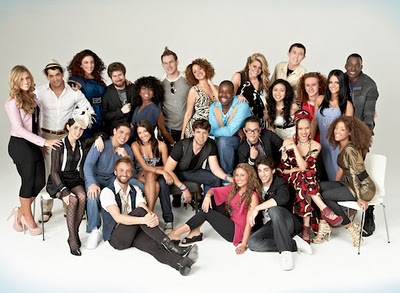
    American Idol: TV's Juggernaut Hits Season 10


    Although it’s unprecedented, I believe I have to post twice in a single day. Don’t get used to it. Depending on how it shows up, I might even reverse time stamp my last post so as not to create any expectations that I'll follow through with blogging to this degree ever again. But it’s that IDOL time of year, and I do have to take stock of my addiction to all things Idol despite how it makes me die a little inside every year. Then I remember that when Idol returns, so do Jacob’s TwoP recaps, which are simply to die for and all is right with the world again. (Seriously, if you haven’t read them, and have any kind of snarky humor about TV, you should check them out).

    So – big news this year, format changes and panel changes. The judging changes have actually been kind of fun. I’ve been enjoying Steven and Jennifer’s additions, at the same time wondering how Randy has suddenly become the Simon of this season. It’s clear, however, that the panel has two new judges when you put through double the number of people to Hollywood that you did in previous years. And thus, the auditions went on FOREVER and I was actually mostly bored. There’s only so many times Steven can creepily hit on under-aged girls before it’s simply not amusing anymore.
     
    This is the second time in this 10-year process where I “know” one of the contestants that made it to the Top 24. [I use the term “know” loosely since there’s a difference between talking/acquainting with someone and being friends with them – so yeah. The only reason I made it through the audition rounds watching all of the footage was to see what happened to Tim Halperin. Go Nebraska! Represent!]

    Now that we’re getting to the competition part, I’m excited again. And I kind of like this new format where they just cut people and get to the real stuff. I hated the painful weeks when it was clear that there was a top half/bottom half and people stuck around week after week. This way we can just cut to the chase. I’m interested to see how this online voting thing will play out – though I’m pretty sure it’s not REALLY going to change the voting demographic all that much.


    Which brings me to my observations/predictions about tonight’s first elimination show. As I mentioned last year, I am constantly amazed at how many contestants fail to see the industry politics of Idol once the performances roll around. You’ve got one shot. The whole point is to give me a song that will convince me to buy an entire album of your music, or at least the single on iTunes. What was painfully obvious to me, but perhaps not to most viewers, is that through the production of the audition rounds, it seemed like they were picking individuals who were musicians rather than just singers. A bunch of the outtakes had contestants playing instruments, yet in this first round, my guess is they weren’t allowed to have them. This made it all the more awkward when people were criticized for “not being themselves” – if you’re a singer/songwriter type (like Tim or Paul), just singing a song doesn’t really show me what you can do.

    That said, PREDICTIONS! Given what I know of this show’s history, what I think of the public’s ability to judge musical talent, and a variety of other industry audience factors (not the least of which includes the gendered, racialized politics of this show), I think there was a pretty clear top-half/bottom-half on both nights.

    For the guys, I think James, Casey, Jacob and Scotty will sail through to the next round. I feel mixed about this because of those four, I can really only conceptualize one of them making an album produced by Idol that will make any money (I’ll let you guess which one). In the fifth spot, it’s a toss up. While I’d like it to be Tim, I think we’ll see Paul – though I wouldn’t count Brett out given the disproportionate number of tween girls who vote on this show and the large number of fans who enjoy voting for the worst contestant in an attempt to see more train-wreck reality TV.

    For the gals, the performances were far more lackluster. That said, I think Pia, Thia, and Lauren A. are locked in to the next round. Personally, I thought Haley was the best of the night though the judges beat up on her, and I think she’ll make it through. In the fifth spot, I’m kind of hoping Lauren T. pulls it out because I like her voice, but if I know this audience at all, it will probably be Naima instead. I suppose I can also say not to count Karen out for a spot. If history is any indication, Latino performers never do well on this show – but with the addition of Jennifer on the judging panel, the viewing demographic might have changed slightly from previous years.

    And that's it for this week. More on Idol in coming weeks, for sure.